
Теория и практика науки и образования №9 (9) Ноябрь 2026 г.
The Art of the Eastern Dialogue: Cross-Cultural Management in the Era of the "Pivot to the East"
Institute of Management at RANEPA (Presidential Academy),
Moscow, Russia
Email: vladislavnr@mail.ru
Novikov V. R. The Art of the Eastern Dialogue: Cross-Cultural Management in the Era of the "Pivot to the East" // Теория и практика науки и образования. — 2026. — № 9 (9). — URL: https://smart-science.net/arhiv/9/3/ (дата обращения: ДД.ММ.ГГГГ).
Теория и практика науки и образования №9 (9) Ноябрь 2026 г.
Introduction: New Realities of Old Models
The geopolitical and macroeconomic tectonic shifts of recent years have forced Russian businesses into an unprecedented, accelerated reconfiguration of supply chains, financial corridors, and investment strategies. The vector known as the "Pivot to the East" has ceased to be a theoretical alternative and has instead become an absolute operational reality. Russian enterprises, stripped of their habitual European markets, have been compelled to urgently seek synergies within the Global South, shifting their focus toward Asia-Pacific and the Middle East.
However, as Russian top management rushed en masse into the markets of China, India, Southeast Asia, and the Middle East, companies encountered a structural barrier that cannot be overcome by merely expanding corporate budgets or optimizing logistics. This barrier is the profound cross-cultural divide. For over three decades, post-Soviet Russian business meticulously adapted to Western corporate standards. This framework emphasized clear-cut transactional contracts, rigid Key Performance Indicators (KPIs), direct and blunt communication ("straight-talking"), and the absolute primacy of the letter of the law over personal relationships. This cognitive shift was heavily reinforced by the absolute dominance of Western MBA and EMBA programs, which for decades served as the exclusive blueprint for Russian executive education.
Attempting to transplant this precise, low-context toolkit onto Asian soil routinely results in gridlocked negotiations, missed deadlines, and sudden, inexplicable cancellations of deals. In today’s global landscape, cross-cultural management has officially transcended the category of a "soft skill" and has been elevated to a critical factor of corporate survival. Businesses are learning that commercial transactions cannot outrun cultural comprehension. Consequently, developing a high Cultural Intelligence (CQ) is no longer a luxury but an existential requirement for transnational operational efficiency [1, p. 42].
- 1.The Hierarchy Trap: Power Distance Index (PDI) Reshuffled
One of the most pervasive blind spots for Russian executives is the illusion of mental alignment regarding authority. On paper, evaluating Geert Hofstede’s cultural dimensions might suggest deep compatibility: Russia scores exceptionally high on the Power Distance Index (PDI) at 89, while China scores an 80, and Arab nations similarly sit at elevated levels [3, p. 87]. In all these regions, one observes rigid subordination, centralized decision-making, and strict command structures.
However, the sociological and historical nature of these hierarchies is fundamentally disparate:
- •The Russian Model: power distance is primarily institutional, transactional, and bureaucratic. It relies heavily on formal administrative status, official job descriptions, explicit enforcement mechanisms, and vertical top-down control matrices [4, p. 65]. Power is exercised through the prism of external compliance rather than internalized philosophical codes.
- •The Eastern Model: hierarchy possesses a sacred, paternalistic character rooted deeply in Confucian ethics (in East Asia) or patriarchal tribal structures in the Middle East. A corporate leader is not merely a high-ranking executive, a professional manager, or an asset owner; they are viewed as the absolute "father" of the corporate family. This dynamic demands absolute, unwavering loyalty and behavioral alignment from subordinates, but in return, it guarantees holistic protection, mentorship, and socio-emotional security.
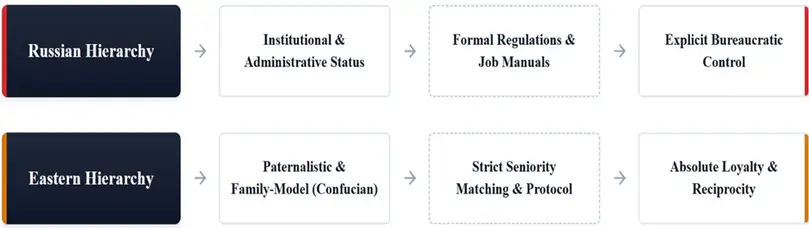
Figure 1. Structural Divergence of Power Distance Dimensions: Russian vs Eastern Corporate Hierarchies.
In practical terms, a Russian manager accustomed to an authoritarian yet direct, highly task-oriented, and dynamic style frequently violates Eastern protocol. For instance, sending a young, brilliant, and highly competent mid-level director to lead negotiations with a senior executive of a Chinese State-Owned Enterprise (SOE) is consistently perceived by the Asian counterpart as a profound personal affront and a blatant disrespect to their status.
Eastern business operates on the ironclad law of seniority matching. Status compatibility must be flawless before any substantive commercial dialogue can even begin. If the corporate hierarchy is bypassed or ignored, it signals a structural lack of respect, leading to a permanent freeze in institutional relations.
- 2.The Phenomenon of "Face" and High-Context Communication
The Western corporate model thrives on constructive friction: open critiques, intense brainstorming sessions where "friction births truth," and unvarnished, direct feedback loops. In highly contextual Eastern cultures (High-Context Cultures, as defined by Edward T. Hall), this exact methodology destroys partnerships permanently [2, p. 54].
At the core of East Asian business ethics lies the concept of Mianzi (Saving Face) in China, or parallel ethical frameworks in Japan (Menboku) and South Korea. These codes dictate that an individual’s reputation, dignity, and social standing within a collective are sacrosanct.
- •Publicly pointing out a mistake made by an Asian partner or subordinate during a joint meeting does not stimulate optimization; it forces them to "lose face".
- •Once Mianzi is compromised, the psychological mechanism shifts from collaborative problem-solving to a total shutdown of communication. The relationship is effectively dead, and no financial benefits can revive it.
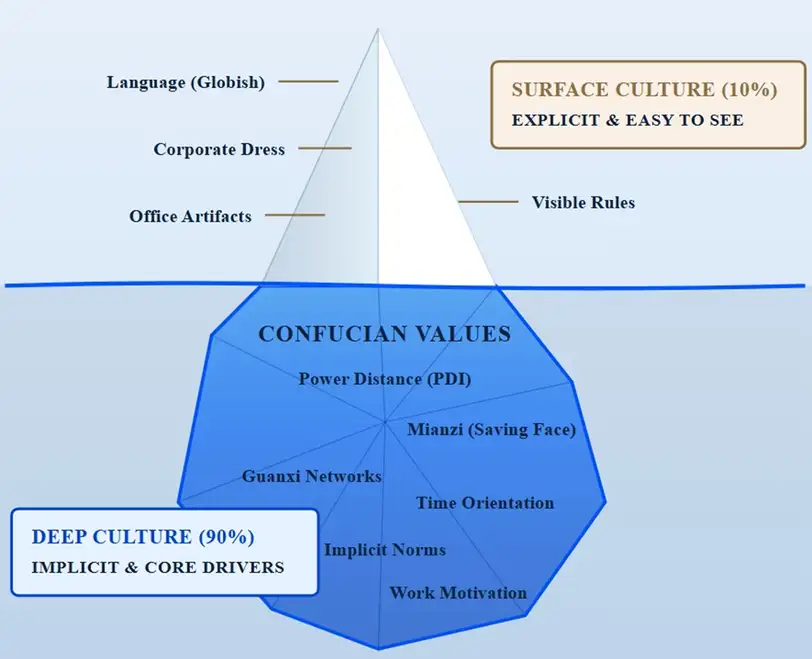
Figure 2. The Cultural Iceberg Framework: Surface vs. Deep Behavioral Drivers in Global Expansion.
Consequently, communication in the East relies heavily on subtle nuances, non-verbal cues, and context. Literal interpretations are a liability. When a Chinese or Southeast Asian partner states, "We will think about this," or "This is an intriguing proposal, but it requires extensive internal coordination," they are issuing a polite, culturally appropriate refusal in 90% of cases.
Russian entrepreneurs, culturally conditioned to take verbal statements literally and demand definitive "yes or no" answers, frequently waste months chasing inherently dead projects because they fail to read between the lines.
- 3.Rules vs. Fluidity: Navigating Uncertainty Avoidance (UAI)
Another fundamental divergence manifests within the Uncertainty Avoidance Index (UAI), which highlights how a society copes with the inherent unpredictability of the future.
Russia exhibits an exceptionally high UAI score of 95. Subconsciously, the Russian corporate mind attempts to mitigate chaos and unpredictability through the hyper-regulation of laws, strict compliance checks, detailed manuals, and exhaustive documentation. A Russian manager requires a comprehensive, ironclad plan and a clearly delineated risk grid before executing a project.
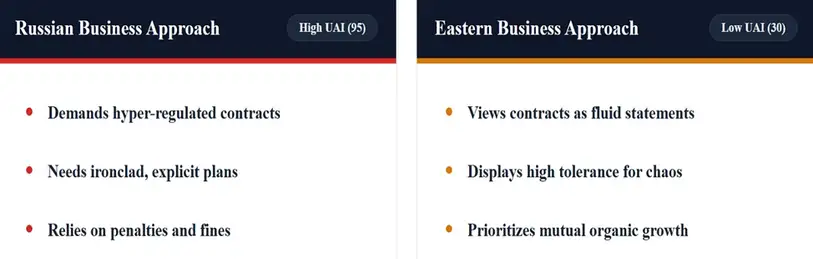
Figure 3. Comparative Analysis of Uncertainty Avoidance (UAI) in Contractual Ecosystems.
Conversely, China scores a remarkably low 30 on the UAI scale, a trait shared by many Southeast Asian economies. These cultures demonstrate an astonishing tolerance for ambiguity and fluid environments. They are highly entrepreneurial, dynamic, and prepared to rewrite the rules of a project mid-game if shifting market conditions require it.
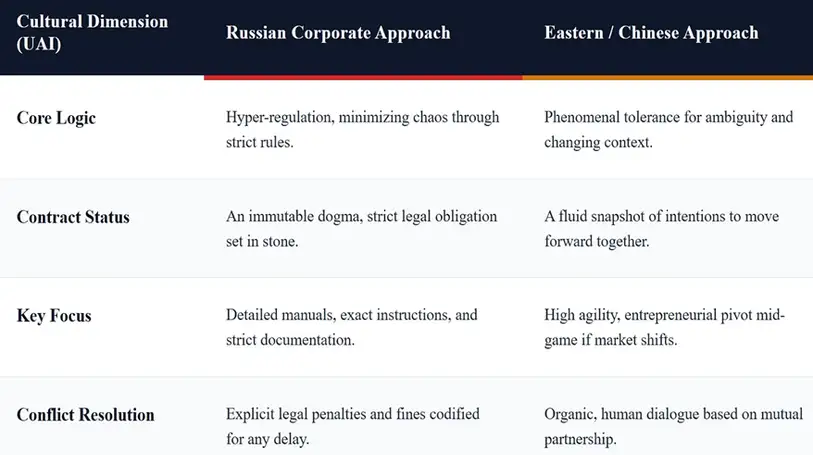
This contrast often paralyzes legal departments. To a Russian corporate lawyer, an Asian contract draft looks suspiciously vague, "watery," and non-binding. To the Asian counterpart, however, a contract is not an immutable dogma set in stone; it is merely a formal snapshot of the current intentions of two friends walking the same path.
They genuinely struggle to comprehend why the Russian side insists on codifying punitive financial sanctions for every single day of delay, thinking: "We are partners now; if a problem arises, we will naturally resolve it as human beings".
- 4.From Transactions to Relationships: India and the Middle East
The macroeconomic "Pivot to the East" is not a monolithic shift toward Beijing; it encompasses the vast, complex markets of India and the Persian Gulf, each requiring its own unique cultural key.
In India, commerce is deeply intertwined with multi-layered networks of family clans (Joint Families), regional identities, and deep-seated historical structures. Time here is distinctly polychronic—it is fluid, continuous, and non-linear. If an Indian partner arrives an hour late to a scheduled meeting or reschedules an appointment for the third consecutive time, it is rarely an act of disrespect. Rather, it reflects a fundamentally different perception of time management where human interactions outweigh artificial timetables. Attempting to apply heavy-handed institutional pressure, aggressive deadline enforcement, or threatening contract clauses will simply cause the partner to disengage and permanently withdraw from communication.
In the Middle East (specifically the UAE and Saudi Arabia), the structural cornerstone of business is Wasta—the Arab equivalent of China’s Guanxi [5, p. 115]. It represents an intricate web of personal loyalty, familial endorsement, and reciprocal favors.
A deal in the Gulf is almost never concluded during the initial rounds of meetings. First, an executive must cross the threshold into becoming an accepted insider. This requires spending hours over shared meals, discussing family, history, and art. In this ecosystem, you do not sell a product or an optimized price point first; you sell your personal honor, reliability, and integrity as a human being.
Conclusion: A Strategic Checklist for Business Transformation
The long-term viability of international trade shifts depends heavily on the capacity of executives to undergo a thorough mental decolonization from inherited Western corporate paradigms. To forge sustainable, resilient alliances with Eastern counterparts, companies must systematically execute three strategic steps:
- •Invest in Time Before Transactions: transition from a "Transaction-First" mindset to a "Relationship-First" model. Reframe prolonged pre-contract dinners, tea ceremonies, and informal dialogues not as costly distractions, but as high-priority corporate work where the actual vetting of the partnership occurs.
- •Master High-Context Linguistics: cultivate the capability to decipher indirect communication. Learn to deliver critique strictly in private under the guise of "collaborative guidance," and never put a partner in a position where they appear incompetent or lose status in front of their subordinates.
- •Develop Cultural Intelligence (CQ): accept that an absence of rigid, granular instructions from an Asian partner is not a symptom of negligence or unprofessionalism. Rather, it is their native mechanism for maintaining operational flexibility in a volatile world. Consequently, CQ development must transcend theoretical awareness and be institutionalized by HR departments through systematic cross-cultural simulations, localized mentorship pipelines, and the strategic deployment of native cultural mediators.
The "Pivot to the East" cannot be reduced to a superficial transition of settlement currencies from Dollars and Euros to Yuan, Rupees, or Dirhams. It requires a fundamental upgrade of the operational system inside the minds of management. In this new era, the market will belong to those who update their cultural software the fastest.
References
1. Earley, P. C. Cultural Intelligence: Individual Interactions Across Cultures / P. C. Earley, S. Ang. — Stanford : Stanford Business Books, 2003. — 392 p.
2. Hall, E. T. Beyond Culture / E. T. Hall. — New York : Anchor Books, 1976. — 320 p.
3. Hofstede, G. Culture's Consequences: Comparing Values, Behaviors, Institutions, and Organizations Across Nations / G. Hofstede. — 2nd ed. — Thousand Oaks : Sage Publications, 2001. — 616 p.
4. Hofstede, G. Cultures and Organizations: Software of the Mind / G. Hofstede, G. J. Hofstede, M. Minkov. — 3rd ed. — New York : McGraw-Hill, 2010. — 576 p.
5. Hooker, J. Working Across Cultures / J. Hooker. — Stanford : Stanford University Press, 2003. — 408 p.